
Quantities by tenant group, contamination, composition, seasonality, custody, contracts and existing diversion destinations.
A REAL PLACE · AN INDEPENDENT EXAMPLE
A shopping center is
an entire carbon economy.
Hundreds of businesses, daily material flows, shared infrastructure, and scientific possibilities—all connected by one place.
Show me what could be possibleMall of America · Bloomington, Minnesota. Independent CRT analysis—not a partnership or active project.
START WITH ONE QUESTION
What are you trying to make possible?
Choose the closest fit. You don't need to know the whole carbon economy to explore it.
THREE WAYS TO BEGIN
Here's what this place could create.
Concepts to investigate—not commissioned workREAL PLACE · DOCUMENTED CONNECTIONS
What we can already establish.
Publicly reported information, separated from the opportunities we still need to prove.
Real operating environmentMall of America
Bloomington, MN · 500+ stores and 50+ restaurants advertised. Source ↗
Owner / property managementTriple Five
Property ownership and management stated by the company. Source ↗
Named operating partnerRepublic Services
Listed as official waste-hauler partner. Contract details and current tonnages aren't public here. Source ↗
Examples of named tenantsChipotle · sweetgreen · Shake Shack
Official dining listings establish location, not willingness to join CRT or share operating data. Source ↗
Historical operating signals, not a current materials audit
In a public interview, mall representatives described approximately 2.4 million pounds/year of recycled paper/cardboard and 460,000 pounds/year of food waste sent to a local hog farm. The mall separately reports over 60% waste diversion. All figures need fresh period, denominator and destination confirmation before project economics can be assessed.
Interview source ↗ · MOA sustainability page ↗ONE HIGH-VALUE STARTING POINT
Can the existing resource system create even more value?
We would begin by understanding what the site and its tenants already recover, where materials go, who is responsible, and which economic improvements could be real.
1. Verify actual flows2. Preserve existing beneficial uses3. Test incremental value
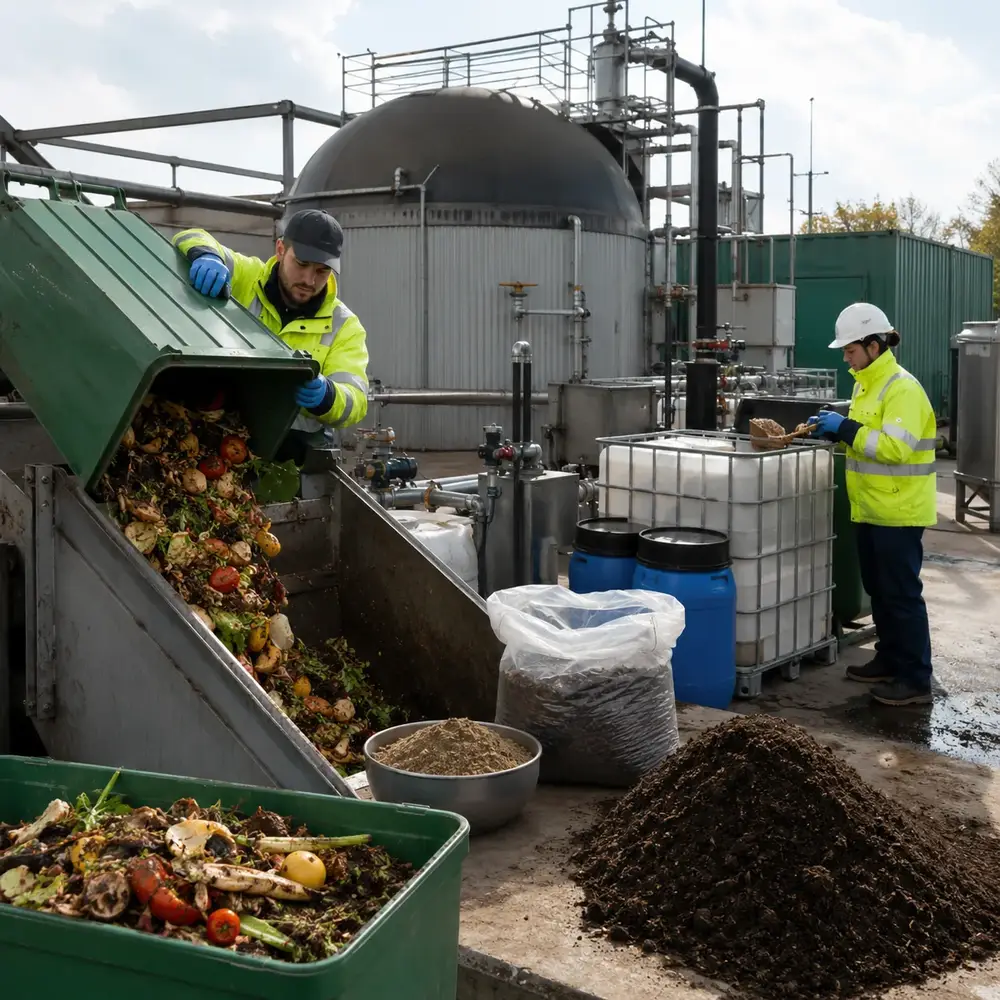 Image illustrates a potential conversion pathway, not an existing mall facility.
PROPOSED FIRST PAID ENGAGEMENT
A 30-day materials and market qualification.
A bounded, sponsor-funded decision study—not a promise to build a plant. No sponsor has agreed to commission this work.
Current waste and hauling costs, revenue, transport, processing fees, baseline environmental effects, and alternative buyer specifications.
Site operator, waste-service provider, willing tenants, qualified laboratories and product or materials buyers—with authority and permissions verified.
Test a defined contamination or feedstock problem, compare the existing route against two alternatives, and issue a go, hold or stop recommendation.
Success looks likeVerified incremental commercial value per tonne or per tenant group
Stop conditionWorse economics or lifecycle outcome than the existing beneficial use
Have authority over a similar property, waste stream or commercial application?
Prepare a nonconfidential introduction. The brief stays in your browser until you choose to send it.
See the complete evidence and missing-data register +
Evidence sources
- MOA Group Experiences — scale and food tenants ↗
- MOA Dining Guide — tenant listings ↗
- MOA Corporate Partners — Republic Services ↗
- Triple Five — Mall of America ownership ↗
- MOA Green Commitment ↗
- MOA + Xcel Energy Podcast — reported operational volumes ↗
- MOA Contact ↗
- EPA shopping-center recycling case study (historic) ↗
Unknowns that prevent a commercialization claim
Current flow measurements; per-tenant participation; contract terms; waste composition; material ownership; storage/hauling capabilities; downstream product qualification; incremental emissions; scientific partners; funding approval.
Presence in this example is not evidence of an agreement, an operating carbon-conversion system, or a sponsor.