Carbon-source inventory
Terminal airflow, HVAC, boilers, CHP, central plants, tenants, concessions, waste, liquids, biogenic materials, materials procurement, and surrounding built-environment infrastructure.
Airports already control passenger flow, baggage flow, fuel flow, waste flow, cargo flow, catering flow, security flow, and ground-vehicle flow. What they do not yet control is carbon flow. Carbon Recycling Technologies identifies, measures, routes, finances, and manages carbon across airport and built-environment infrastructure.
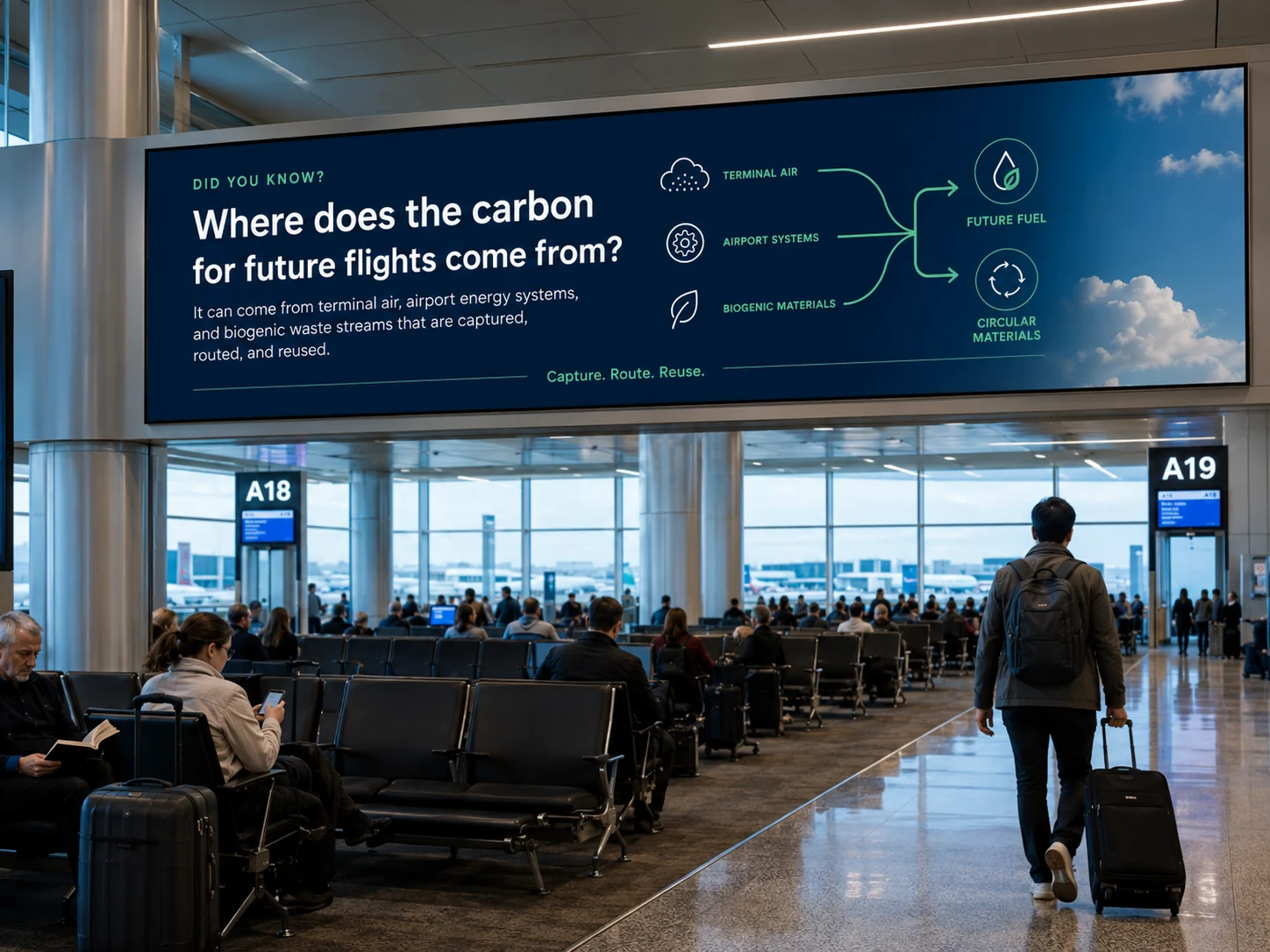 Capture. Route. Reuse.
Airport HVAC CO₂ capture alone is too dilute to carry the economics. But as part of a broader carbon flow control architecture across HVAC systems, boilers, CHP units, central plants, tenants, concessions, biogenic materials, construction materials, SAF demand, and regional offtake hubs, airports can become measurable carbon-resource nodes.
The Phase 0 assessment produces a decision-ready map. The operating model turns that map into a managed carbon-resource program that can be funded, piloted, governed, and repeated.
Terminal airflow, HVAC, boilers, CHP, central plants, tenants, concessions, waste, liquids, biogenic materials, materials procurement, and surrounding built-environment infrastructure.
SAF/e-fuel, durable CDR, circular materials, CO₂ utilization, purchased CO₂ displacement, verified diversion, or storage where appropriate.
Of-take agreements, CO₂ logistics, biogenic feedstock routes, storage and mineralization pathways, university/lab partners, vendor networks, and financing structures.
Each assessment can be scaled to one airport, a regional airport carbon hub, an airline network, or a multi-site built-environment portfolio.
What streams exist, where they originate, who controls them, and what data is needed.
Realistic capture potential, dilution limits, energy implications, and integration logic.
Denser sources, retrofit options, capture pathways, and operational constraints.
Food waste, packaging, UCO, organics, wastewater, hauler routes, AD, biochar, composting, and MRV logic.
Who controls which streams, how participation is designed, and how education becomes demand.
SAF, e-fuel, CDR, circular materials, CO₂ utilization, public buyers, and corporate sponsors.
Eligibility, claims boundaries, incentive routes, carbon accounting, and MRV readiness.
Practical sequencing from quick wins to FOAK development to portfolio-scale replication.
Start with a Phase 0 Carbon Flow Control Map, then route the highest-value streams into the strongest technical, commercial, and financing pathway.