Atmospheric CO₂
May support removal only when permanently stored or durably mineralized. If converted to fuel, the more conservative claim is carbon recycling or fossil displacement, not permanent removal.
A ton of fossil CO₂, atmospheric or terminal-air CO₂, used cooking oil, food waste, mixed MSW, methane, or biochar carries a different claim boundary. Carbon Recycling structures chain-of-custody, Scope relevance, evidence boundaries, and public language so airports, airlines, tenants, and concessions can communicate only what they can prove.
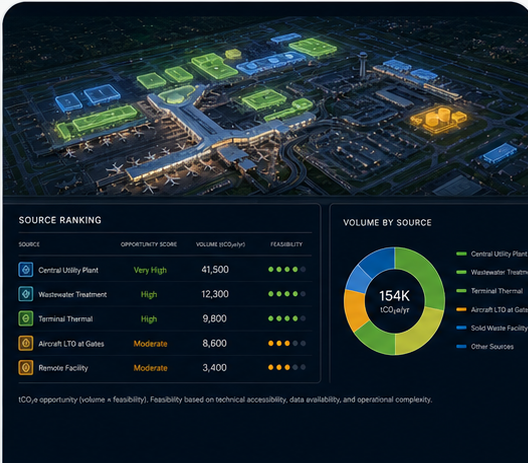
Carbon Recycling Technologies’ MRV framework separates what happened physically from what can be claimed legally, commercially, and publicly. The goal is to make the carbon recycling system credible for airports, airlines, tenants, vendors, capital, regulators, and the public.
May support removal only when permanently stored or durably mineralized. If converted to fuel, the more conservative claim is carbon recycling or fossil displacement, not permanent removal.
May support emissions reduction, utilization, storage, or recycled-carbon fuel claims, with biogenic-removal treatment reserved for pathways and accounting that support that claim.
Food waste, used cooking oil, biomass, paper, and organics may support renewable feedstock, diversion, methane avoidance, biochar, compost, or biogenic storage claims depending on pathway.
Airport trash and MSW require separation or accounting for fossil and biogenic fractions. Waste-to-fuel pathways need careful lifecycle and double-counting controls.
Landfill gas, AD gas, and wastewater gas may support methane mitigation, RNG, energy recovery, and CO₂ capture claims. Credit ownership and double counting must be controlled.
Biochar, hydrochar, mineralized products, aggregates, or durable materials may support storage claims only when durability, mass balance, and end-use tracking are defensible.
Carbon Recycling Technologies’ MRV logic is designed for multi-stakeholder airport environments where the airport, city, airline, tenant, vendor, hauler, fuel producer, or registry may each have different rights.
Physical source, meter, contract, facility, tenant, hauler, generator, or regional asset.
Collection, capture, sorting, hauling, treatment, storage, transfer, blending, or conversion data.
SAF, e-fuel, RNG, compost, biochar, material, storage, utilization, recycled product, or disposal.
Ownership, allocation, Scope boundary, registry logic, credit status, public claim, and double-counting prevention.
Waste to Wings explains that materials can be routed toward future fuel, recycling, composting, RNG, biochar, circular materials, or approved disposal. Carbon Recycling Technologies separates passenger education from verified downstream claims so airports avoid implying that every discarded item becomes SAF.
Signage can explain carbon-bearing resources and sorting routes in plain language.
Claims require weights, route logs, processor data, contamination rates, chain of custody, and destination confirmation.
Carbon Recycling Technologies distinguishes diversion, recycling, utilization, SAF feedstock, emissions reduction, storage, and durable removal.
Make carbon recycling infrastructure visible while keeping every claim conservative, evidence-based, and defensible.