Paid opportunity map
Airport, airline, corporate, public, university, or sponsor-funded assessment to define the sources, routes, buyers, and project roadmap.
Airport carbon economics become stronger when sources, routes, buyers, sponsors, and capital are stacked together. HVAC capture may carry high capture, conditioning, compression, liquefaction, and storage costs. But broader carbon flow control can combine energy savings, concentrated sources, biogenic streams, offtake, CDR prepurchase, public funding, and regional aggregation.
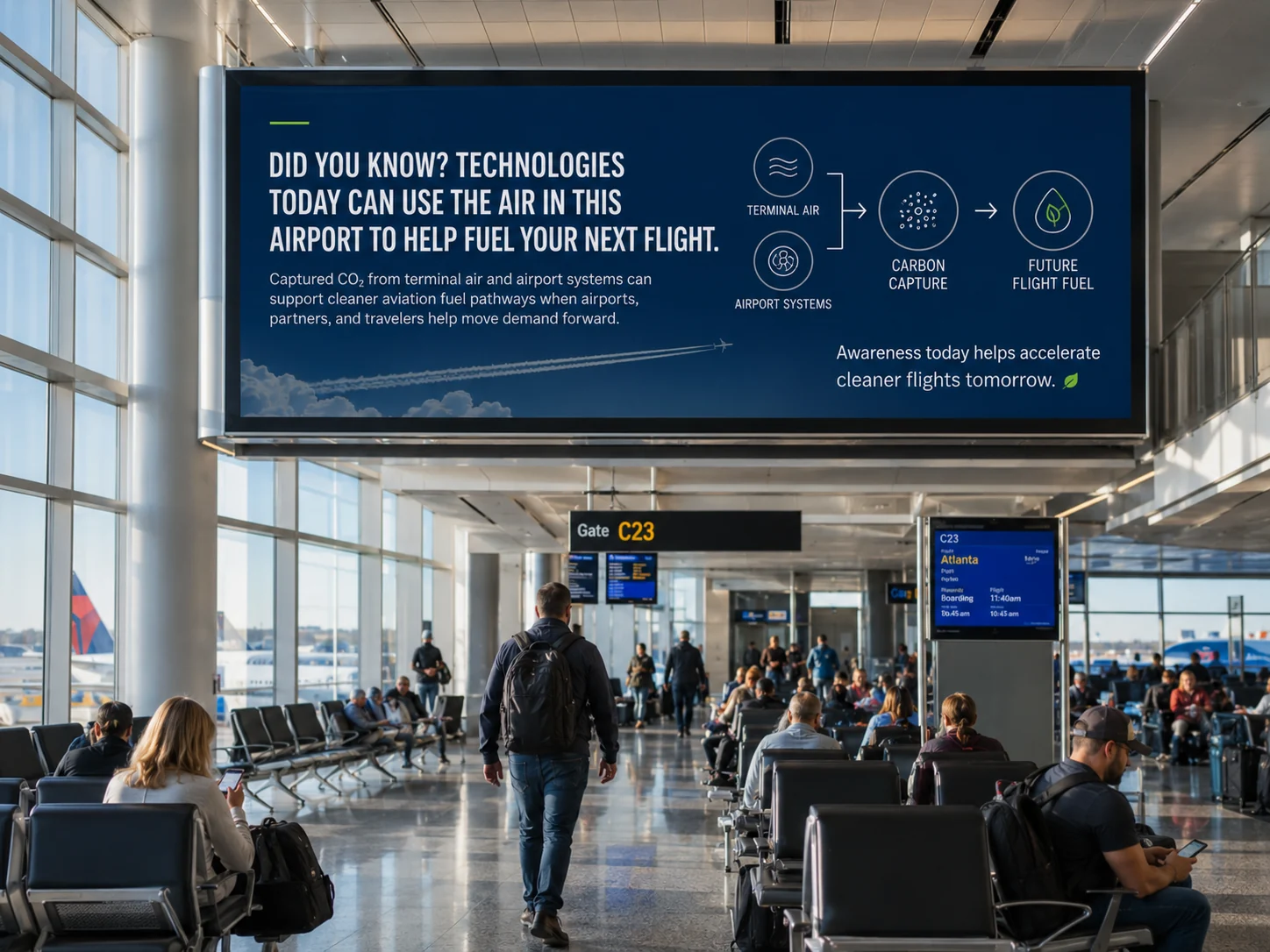 Awareness → Demand → Finance → Build
Instead of asking whether one airport HVAC capture unit can pay for itself, CRT maps all carbon streams and routes them into a stack of buyers and beneficiaries. One actor may value SAF relevance. Another may value durable CDR. Another may value circular materials, waste diversion, tenant activation, energy optimization, public leadership, or first-of-a-kind technology development.
Air, energy, waste, organics, liquids, materials, tenants, and surrounding infrastructure.
Ownership, contracts, operations, data access, procurement, and claims boundaries.
SAF/e-fuel, CDR, circular materials, CO₂ utilization, diversion, storage, or future hubs.
Airlines, corporates, tenants, CDR buyers, fuel partners, materials buyers, and public agencies.
Cost-share, offtake, prepurchase, grants, tax incentives, vendor co-development, and project finance.
Retrofits, pilots, FOAK projects, hub infrastructure, and portfolio replication.
CRT helps sequence the financing logic so early money buys clarity, and later money funds implementation.
Airport, airline, corporate, public, university, or sponsor-funded assessment to define the sources, routes, buyers, and project roadmap.
Long-term buyer intent can help justify carbon sourcing, hydrogen, conversion, logistics, and future fuel infrastructure.
Durable removal buyers can support biochar, mineralization, storage, biogenic CO₂ capture, and MRV-ready project development.
Airport construction, tenants, brands, and suppliers can create demand for mineralized materials or circular products.
Regional climate infrastructure, airport innovation, waste diversion, workforce, research, and economic-development funding.
Qualified vendors contribute pilots, pricing, integration, data, technical scope, or preferred deployment terms.
Facilities, central plant, HVAC, waste, concessions, sustainability, and capital planning budgets can each support the part they benefit from.
Aggregated airports, sources, buyers, and routes can support infrastructure finance that one source could not justify alone.
CRT does not hide the hard economics. It separates where value is created, where cost is added, and what combination of sources and buyers can carry the project.
| Pathway | Economic upside | Cost / constraint | How CRT makes it stronger |
|---|---|---|---|
| HVAC / terminal air CO₂ | Energy savings, indoor air optimization adjacency, visible traveler story, distributed source logic. | Very dilute CO₂; capture, conditioning, compression, liquefaction, storage, and MRV can be costly. | Use as one node inside a broader airport carbon network, not as the sole economic engine. |
| Boilers / CHP / central plants | Higher CO₂ concentration, existing energy infrastructure, clearer retrofit pathway. | Site-specific access, downtime, equipment fit, heat/power tradeoffs, capture integration. | Screen sources during Phase 0 and route dense streams before lower-density streams. |
| Biogenic materials | Potential CDR, methane avoidance, waste diversion, public visibility, tenant participation. | Contamination, hauling, sorting, contracts, digestate, MRV, permanence depending on pathway. | Use SmartSort/Pink Dot-style routing, chain-of-custody, AD/biochar/mineralization screens, and buyer-backed routes. |
| SAF / e-fuel offtake | Large aviation demand signal, airline strategic value, infrastructure relevance. | Long timelines, conversion cost, hydrogen/energy demand, certification, feedstock limits. | Pair airport carbon-source mapping with regional fuel partners and staged offtake logic. |
| Durable CDR prepurchase | Can finance first-of-a-kind removal pathways if MRV and permanence are credible. | Strict claims, storage durability, additionality, delivery risk, verification burden. | Separate CDR from utilization/diversion and only claim removal where storage and MRV support it. |
The model works when the cost stack is aligned with the benefit stack.
Source inventory, capital roadmap, tenant coordination, ACA and Scope relevance, procurement logic, and public leadership.
Hub strategy, Scope 3 collaboration, passenger trust, SAF/e-fuel optionality, and CDR buyer pathways.
Technology translation, sponsored opportunity development, pilots, testbeds, licensing, and market-pull alignment.
Better site context, clearer buyer, lower pilot friction, data needs, and route-specific integration.
SAF, CDR, circular products, CO₂ utilization, materials procurement, and claims-safe sourcing.
Climate infrastructure, jobs, waste diversion, innovation, airport competitiveness, and economic development.
The first step is not a hardware proposal. It is a carbon flow control map that shows what exists, what is valuable, who benefits, and which route can become financeable.