Carbon removal connected to aviation
Passengers, airlines, airports, tenants, and public agencies can see the system forming around real airport carbon streams instead of a remote credit purchase with no operational connection.
Airports do not just emit carbon. They can control, influence, use and remove it.
Beyond SAF, airports can help originate durable carbon removal pathways from the same Carbon System Resource Map and Model. Carbon Recycling Technologies helps airports identify whether airport-controlled and airport-adjacent carbon streams can support credible CDR, while also clarifying which streams are better suited for circular materials, fuel, or utilization routes.
This is not a claim that every airport is already a carbon removal project. It is a Phase 0 method for finding which airports, streams, SmartSort layers, processing routes, storage pathways, partners, pre-purchase structures, and MRV systems could form a credible first-mover CDR portfolio.
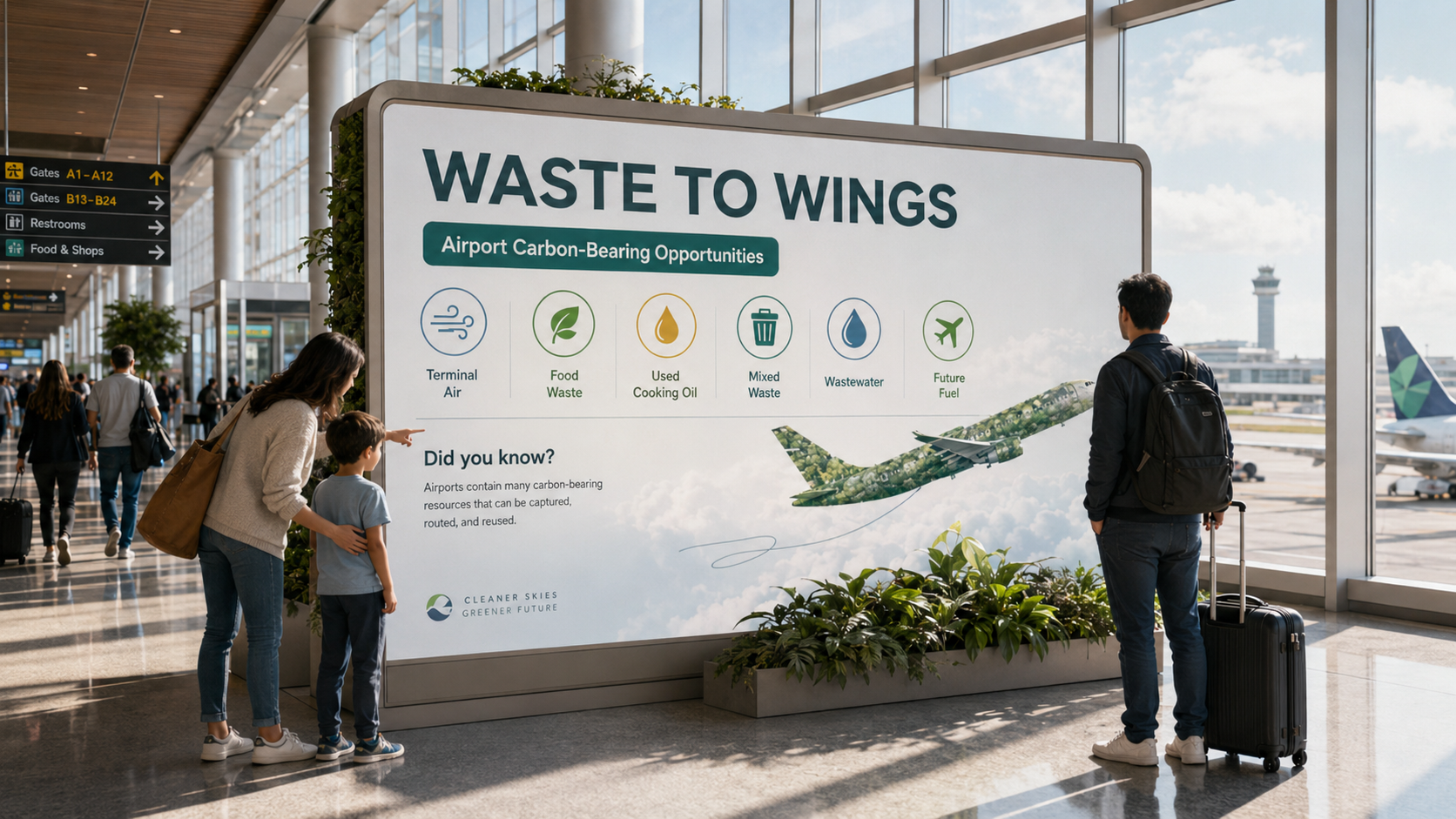
A coordinated portfolio can screen smaller controlled airport carbon streams into larger buyer-facing opportunities: airports, concessions, wastewater, organics, SmartSort-enabled separation, AD, SOFC, biogenic CO₂ capture, digestate stabilization, biochar, mineralization, storage, and MRV.
Most CDR purchases happen far away from the customer, passenger, airport, or aviation system. Airport-anchored CDR creates a different thesis: controlled carbon streams inside and around aviation hubs can be mapped, routed, verified, and converted into durable removal where the science and storage pathway support the claim.
Passengers, airlines, airports, tenants, and public agencies can see the system forming around real airport carbon streams instead of a remote credit purchase with no operational connection.
Boeing, American Airlines, and United-related activity show that durable carbon removal is becoming part of aviation climate strategy. Airports can become origination points for the next wave of aviation-linked CDR.
Some aviation buyers enter through SAF. Others may enter through CDR. The Phase 0 map lets the same airport resource picture serve both circular fuel pathways and durable removal pathways.
The strongest CDR strategy is not to force one airport to carry the full burden. It is to identify the first 20 airports where controlled organic carbon, wastewater, concessions, airline catering, regional organics, infrastructure partners, and storage routes overlap.
Carbon Recycling Technologies separates ordinary sustainability activity from CDR by mapping feedstock provenance, ownership, processing route, CO₂ capture, durable storage, leakage risk, permanence, additionality, and MRV before a credit or buyer claim is made.
Food waste, wastewater solids, airline catering waste, concessions organics, used cooking oil, grease, regional organics, and other airport-adjacent biogenic streams.
AD, depackaging, preprocessing, SOFC, CHP, turbine, hydrothermal processing, pyrolysis, biogas upgrading, or partner-specific systems selected after Phase 0.
Capture from biogas upgrading or combustion exhaust, or stabilize residual solids into durable carbon forms where evidence supports long-term storage.
Geologic storage, mineralized materials, biochar, hydrochar, bio-oil storage, or other evidence-backed sinks. Diversion alone is not removal.
Track source, control, chain of custody, avoided emissions, captured carbon, storage durability, leakage, permanence, and allocation across Scope and credit boundaries.
Route the same airport carbon map toward CDR buyers, aviation customers, public funders, corporate climate buyers, or SAF pathways depending on the stream.
For the CDR pathway, SmartSort becomes more than waste education. It becomes a controlled separation and storytelling layer that can help airports distinguish organics, packaging, fossil-derived materials, and residual streams from the cabin to the terminal.
Flight crews can use simple branded bags, icons, and labels to separate organics and other material classes onboard, making carbon-routing more visible and more practical before waste becomes mixed in the terminal.
Concessions, lounges, custodial teams, and tenants can use SmartSort logic to improve source separation for organics, packaging, and residual streams that may feed AD, capture, stabilization, or diversion pathways.
Color-coded, multilingual, and accessibility-aware signage turns hidden back-of-house systems into a public carbon story: what is being collected, why it matters, and how airports can help create visible climate infrastructure.
Airport CDR depends on what is actually in the stream. SmartSort helps reduce confusion between organics, plastics, packaging, and other materials so airports can more credibly assess whether a stream belongs in AD, SOFC + capture, digestate stabilization, biochar, mineralization, or a non-CDR route.
This does not mean CRT should overclaim airport CDR today. It means aviation buyers are beginning to understand CDR, making airport-originated CDR easier to explain, sponsor, and evaluate.
Boeing has announced multi-year durable carbon removal activity, including a Carbonfuture agreement for at least 40,000 tonnes of durable CDR credits.
View sourceAmerican Airlines announced a 10,000-ton permanent carbon removal purchase agreement with Graphyte, showing airline interest in durable removal beyond conventional offsets.
View sourceUnited’s Sustainable Flight Fund announced an investment in Heirloom with rights to purchase up to 500,000 tons of CDR for SAF production or permanent underground storage.
View sourceThe page is intentionally claims-safe. Airport CDR should only be claimed where carbon is durably stored or sequestered with adequate evidence. Other activities may still matter for Scope, fuel, utilization, diversion, cost savings, or public leadership, but they should not be mislabeled as CDR.
Once the Carbon System Resource Map and Model identifies the strongest pathway, the buyer signal can take different forms. Depending on the stream, the route, and the partner, the pre-purchase or commercial commitment may be SAF, circular materials, durable carbon removal, CO₂ utilization, or a buyer-backed pilot.
The CDR page gives airports and aviation partners a second major entry point beyond SAF. SAF-first buyers can use the map to find circular fuel pathways. Other partners may be more aligned with durable removal, circular materials, or utilization. The system can speak to each route without forcing one output too early.
Used cooking oil, CO₂, hydrogen relevance, waste carbon, regional feedstocks, and airport demand can be mapped toward fuel and aviation supply-chain strategies.
Organic carbon, biogenic CO₂, digestate, wastewater, biochar, mineralization, and storage can be mapped toward high-integrity removal where feasible.
Some airport carbon streams may be best routed into circular materials, CO₂ utilization, or other climate-value products rather than SAF or CDR, and the map helps make that decision earlier.
Begin with a Carbon System Resource Map and Model to rank streams, SmartSort layers, control points, processing options, storage routes, MRV needs, and where CDR is stronger than circular fuel or utilization.