Carbon Resource Inventory Pilot
Begin by mapping and metering a bounded set of streams: central plant CO₂, terminal air, used cooking oil, food waste, mixed waste, tenant zones, or regional source candidates.
The service identifies the first stream and pilot structure that provides measurable data, operational safety, stakeholder alignment, claims discipline, and expansion value.
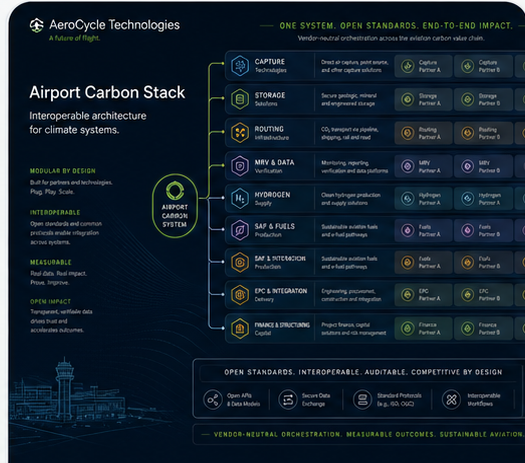
Begin by mapping and metering a bounded set of streams: central plant CO₂, terminal air, used cooking oil, food waste, mixed waste, tenant zones, or regional source candidates.
Select one measurable stream with clear control and near-term action. This may be boiler/CHP CO₂, used cooking oil aggregation, food-waste diversion, or a tenant-linked waste pathway.
Evaluate which streams can credibly support SAF or SAF-adjacent pathways: HEFA feedstocks, MSW fractions, captured CO₂ plus hydrogen, alcohol intermediates, biogas, or regional waste-to-fuel infrastructure.
Route a stream to a verified use such as SAF/e-fuel partner, RNG, biochar, compost, mineralized materials, industrial reuse, storage, purchased CO₂ displacement, or verified diversion.
Bring concessionaires, airline lounges, hotels, catering, janitorial, cargo, and ground operators into a controlled carbon-resource participation model with clear boundaries and data rules.
Expand beyond the airport boundary to municipal waste, wastewater, landfill gas, WtE, universities, labs, hydrogen, SAF producers, and infrastructure capital.
Captured CO₂ becomes fuel-relevant when paired with clean energy, hydrogen, conversion infrastructure, and qualified downstream partners. Waste-derived carbon becomes fuel-relevant only when feedstock quality, collection, preprocessing, lifecycle accounting, and regulatory requirements are credible.
Carbon Recycling Technologies organizes the airport carbon resource management program so each stream can be mapped, verified, routed, and matched to the right downstream pathway without overclaiming SAF, removal, or climate value.
Some sources are candidates for electrification. Some are candidates for optimization, composting, recycling, diversion, digestion, aggregation, gasification, capture, or no-action reduction. Carbon Recycling Technologies makes those distinctions before an airport spends capital.
Phase 0 defines the right first pilot by stream type, claim boundary, stakeholder control, and scalability.